
| Version | 7.1 |
|---|---|
| Größe | 137 MB |
| Aktualisiert | 1. Okt. 2026 |
| Kategorie | Tools |
| Benötigt | Android 8.0 |
| MOD-Info | Premium |
| Google Play | com.hssn.anatomy3d |
MOD-Funktionen
- Premium Version
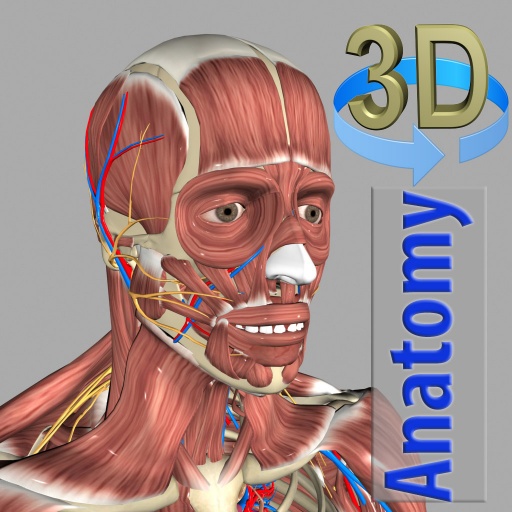
3D Anatomy is an Android application designed to support learning about human anatomy using interactive 3D models. Users can not only view static images but also rotate, zoom, and dissect the models to observe internal structures in detail. This app is ideal for medical students, self-learners, or anyone who wants to gain a deeper understanding of the human body through a more visual learning experience.
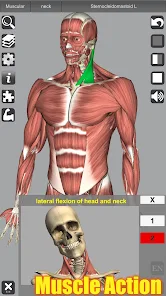
Overview of 3D Anatomy
The strength of 3D Anatomy lies in its user-friendly touch interface, allowing users to explore the human body from various perspectives. Learners can show/hide individual organ systems, search for the names of structures, and pinpoint their exact location on the 3D model.
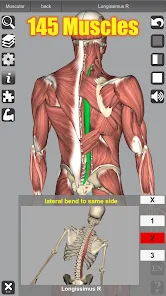
Notable features of the app include the skeletal system, ligaments, bony landmarks, muscles, circulatory system, nervous system, respiratory system, urinary system, reproductive system, and ear. Notably, the muscle section features 145 detailed models, along with motion videos and physiological animations to help learners visualize how the parts function.
Explore the body through 3D models
With 3D Anatomy, users can rotate models from multiple angles and zoom in on areas of study. The layer separation feature allows observation of deeper structures without needing to navigate through separate illustrations.
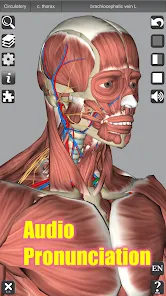
The app allows you to show/hide individual organ systems to focus on the content you need to learn. For example, when reviewing muscles, users can hide other systems to simplify the model. A quick search tool helps pinpoint the location of structures on the model accurately.
Anatomy knowledge practice and testing section
In addition to observing models, 3D Anatomy also provides 3D location quizzes for learners to self-assess their memory skills. This method helps transition from simply looking and reading the name of a structure to actively identifying its location on the body.
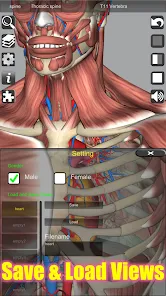
The app also features over 100 videos simulating muscle function, physiological animations, and pronunciation of terminology in audio. The terminology supports English, French, Spanish, and German, suitable for learners who want to combine professional knowledge with foreign languages.
Tips and instructions for using 3D Anatomy
To learn effectively with 3D Anatomy, start with the skeletal system, then move on to muscles, ligaments, and other organ systems. When first encountering a structure, rotate the model to observe it from multiple directions, then try turning off other layers and re-identifying the location.
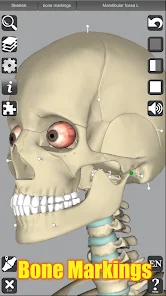
The quiz section should be used after completing each topic rather than just reading the information. If you answer incorrectly, return to the model, find the correct structure, and memorize its relationship to the surrounding parts. The app can support students as a supplementary tool for textbooks and learning materials, rather than a complete replacement.
Conclusion
3D Anatomy provides a visual learning method for anatomy through interactive 3D body models. Functions such as rotating, zooming, layer separation, structure search, muscle animation viewing, and location quizzes make memorization more engaging. With content including multiple organ systems and 145 detailed muscle models, the app is a useful tool for learning anatomy on Android.